Living in New Eden: The Architecture of Freedom and Comfort in the Tropics
0Frank J
- December 14, 2025
- Regenerative Architecture

Escaping the Concrete Oven
The standard approach to modern building in Panama, and much of the tropics, is a fundamental failure of design. Developers usually import “Northern” architecture: sealed concrete boxes with large glass windows designed for cold climates.
In the tropics, a concrete box is an oven. It absorbs intense daytime heat and radiates it inward all night long. To make it habitable, you must fight nature with massive air conditioning systems, resulting in enormous energy bills and total dependence on a fragile electrical grid. If grid power fails, the standard modern house becomes unlivable within hours.
At New Eden, we refuse to live like that. We are not fighting the tropics; we are engineering our way around it.
Our architectural philosophy is Bioclimatic Design. We use physics, geometry, and local materials to create homes that naturally stay cool, dry, and comfortable—drastically reducing, or even eliminating, the need for mechanical air conditioning.
This is not just about being “green.” It is about resilience. A New Eden home is a sanctuary that ensures your comfort is sovereign, regardless of what happens to the outside world’s infrastructure.
The Aesthetic: Tropical Modern Fusion
We reject the damp “primitive shack” aesthetic of many eco-villages, just as we reject the sterile high-rises of the city.
We call our aesthetic Tropical Modern Fusion. It is a marriage of industrial precision and organic warmth, a home designed to look as striking on an architectural magazine cover as it does nestled in the Panamanian canopy.
As you can see in the architectural visualization below, the design balances clean, angular lines with rich, natural textures.
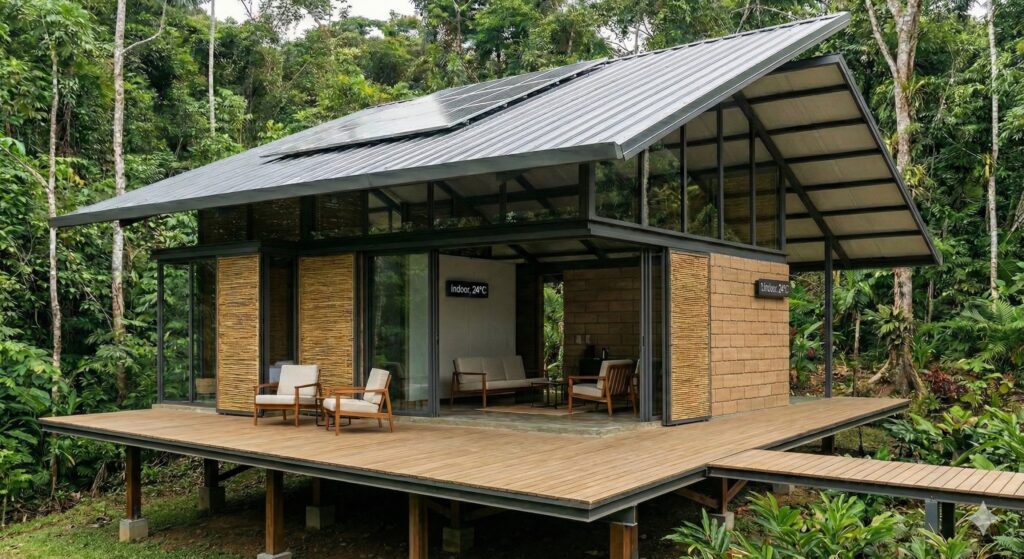
Above: The New Eden archetype home. Note the steep solar roof, elevated foundation, large glass openings, and the distinct texture of the Compressed Earth Block walls.
The silhouette is defined by the sharp lines of the steel frame and the dramatic, steeply pitched roof. Yet, these industrial elements are softened by the warmth of the materials: the golden hues of woven bamboo screens, rich timber decking, and the earthy solidity of the block walls. Through extensive use of sliding glass, the boundary between your living area and the rainforest is dissolved. You are protected from the elements, but completely immersed in the environment.
The Engine: How the House Keeps You Cool
A house in the tropics has two primary enemies: Direct Sun and Torrential Rain. The New Eden home utilizes three non-negotiable structural defenses to keep you comfortable naturally.
1. The “Big Hat” (Roofing and Insulation)
The roof is the most critical element. Ours extends 1.5 to 2 meters beyond the walls on all sides. Rule #1: Direct sunlight must never hit the glass. If sun hits glass, you have built a greenhouse. Our deep eaves ensure your living spaces remain in deep shade.
Furthermore, unlike traditional noisy tin roofs, ours features a thick layer of rigid foam insulation sandwiched between the metal exterior and the interior ceiling beams (visible in the image above between the rafters). This stops the sun’s radiant heat from ever penetrating your living space.
2. The “Big Boots” (Elevated Stilt Foundation)
We do not build on the ground. As shown in the exterior view, the entire structure is raised on steel pilings. This allows cool breezes to flow under the house, cooling the floorboards from below. It also provides crucial resilience against flash flooding during the rainy season and creates a physical barrier against termites and tropical pests.
3. The “Thermal Chimney” (Passive Ventilation)
We don’t need electric fans if we design the house to breathe itself. Hot air naturally rises. Our living spaces feature high, cathedral-style ceilings with vents at the apex. As hot air escapes the top, it creates a vacuum that pulls cooler, heavier air in through low windows near the shaded forest floor. This creates a constant, silent, natural breeze through your home, 24/7.
Inside the Home: The Layout
The layout of the home is designed to maximize the tropical lifestyle—blurring the lines between indoor and outdoor living while providing a secure, private sanctuary.
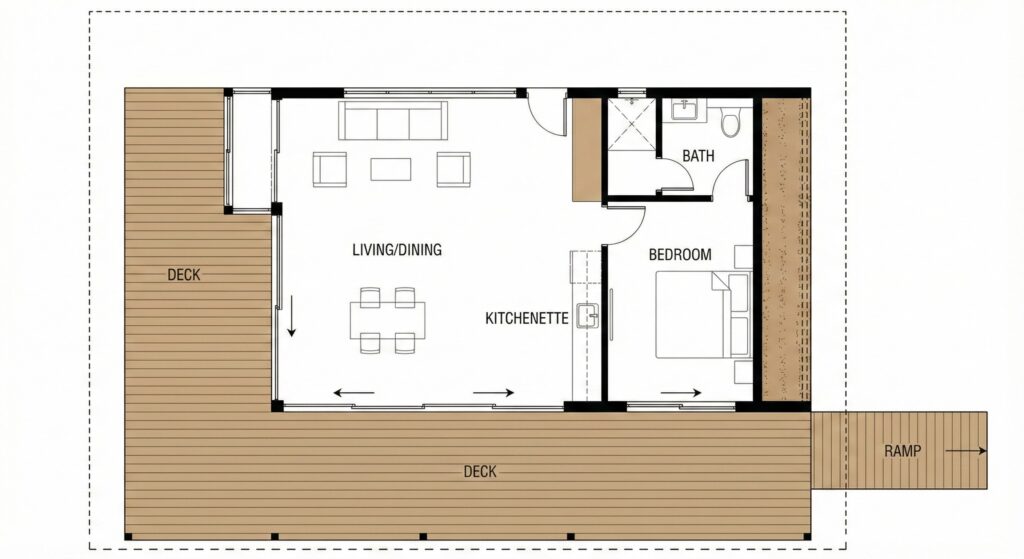
Above: The floor plan showing the expansive wrap-around deck, the open-concept living/dining area, and the secure, enclosed block section for bed and bath.
Looking at the plan above, you can see how the home flows:
- The Decks: Nearly half the square footage is dedicated to a massive wrap-around timber deck. In the tropics, this is your primary living room, dining room, and hammock space.
- The Open Living Area: The indoor kitchen and lounge area are bounded by large sliding glass doors and bamboo screens. When opened, this space becomes one with the deck.
- The Sanctuary (Bedroom & Bath): The private quarters are enclosed within thick, solid walls (the shaded area on the plan). This provides acoustic privacy and a secure, cooler environment for sleeping.
Materials: The “Lego” Approach to Construction
To build efficiently in a remote location with community labor, we selected a hybrid construction system that is modular, durable, and empowers the community.
- The Skeleton (Structural Steel): We use a prefabricated steel frame because it is termite-proof, seismic-resistant, and incredibly strong. It goes up fast, creating an immediate dry roof to work under.
- The Open Walls (Bamboo & Glass): Woven bamboo panels act as breathable screens that provide privacy without blocking airflow. Large-format glass maintains that vital connection to nature.
- The Solid Walls (Compressed Earth Blocks – CEBs): This is the heart of our strategy. Instead of labor-intensive rammed earth, we use CEBs for the private sections of the house.
Why CEBs?
As seen in the exterior image, these blocks give the walls a beautiful, warm, stacked-stone aesthetic. They are essentially “super-adobe bricks,” made by compressing local subsoil mixed with a tiny amount of cement in a hydraulic press.
Like a cave, these thick earth walls have high thermal mass—they absorb heat during the day to keep the inside cool, and release it at night. Crucially, this allows us to avoid importing expensive materials. We buy one block press, and the New Eden community becomes its own brick factory, using the very ground beneath our feet to build our future.
Engineering Freedom
Outside, the tropical sun is relentless. Inside, your home is a cool, shaded oasis.
This is not just an experiment; it is a new standard for living. We intend to build homes that offer the spaciousness and amenities a modern family expects, but with a critical difference: true infrastructure independence.
By replacing the monthly utility bill with superior design, these structures do more than just house us. They liberate us. This is what it looks like to secure your physical baseline against an uncertain world.


Add your first comment to this post